Welcome to Sri Ganganagar - A Beautiful Green Place.........
Sri Ganganagar is one of the well planned cities of India. It is said to be influenced by the town planning of Paris. It is divided into residential blocks and commercial area which includes Dhan Mandi. Residential Blocks have large parks for each Blocks and Community centers and places of worship are at junctions of three or four blocks.Bagri and Punjabi languages are spoken by majority of population.Sri Ganganagar is a northern most city of Rajasthan State of western India.Sri Ganganagar is situated at the point where the Satluj Waters enters Rajasthan.
Econonmy of Sri Ganganagar District is dependent on agriculture.The city has Cotton Ginning and Pressing factories, Mustard Oil mills and Sugar Mills Ltd.
It also has spinning and textile Factories. Because of its prosperity from agriculture, Sri Ganganagar District also has a large number of automobiles and it becomes one of the largest automobile markets in India.
City and Layout
Economy
Climate
The climate of Sri Ganganagar is very extreme. The Summer Temperature reaches up to 50° Celsius and Winter Temperature dips just around 0° Celsius. The average annual rainfall is only 20cms.
Geography

Demographics
Educational Institutes
- Global School
- Gupta Baal Bharti Girls Sen. Sec. School
- Bhopal Wala Arya Higher Sen. Sec. School
- Saint Soldier Public School (7A, outskirts of the city)
- Guru Harkrishan Public School
- Sri Guru Nanak Khalsa Higher Sen. Sec. School (Since 1939)
- B. S. F Senior Secondary School
- Good Shepherd Public School
- Bihani Children's Academy
- Nosegay Public School
- Sacred Heart Convent School
- Blooming Dales International School
- Invention Public School
- Tiny Tots Public School
- Saraswati Public School
- Seth G. L. bihani S. D. Sen. Sec. School
- Seventh Day Adventist Senior Secondary School
- Arorvansh Public School
- S. R. Public Senior Secondary School
- Euro Kids International School
- Govt. Sen. Sec. School(This is one of the oldest school and Popularly Known as Multi-Purpose School)
- Kalindi Public School
- Saint Dhruv Public School
- Gyandeep Shikshan sansthan (3E chhoti,S.S.B.Road)
- Kids Camp Convent School
- Alora Children Academy
- Aryan Public Sec. School
- Sri Guru Nanak Khalsa College
- Sri Guru Nanak Khalsa Law College
- Bharti Institute of Pharmacy Sciences
- Seth G. L. Bihani S. D.(P. G.) College
- Sri Guru Nanak Khalsa Law College
- Govt. Law College
- Maharshi Dayanand (PG) College
- CH. Ballu Ram Godara Girls College
- CH. Malu Ram Bhambu Govt. Polytechnic College
- Shri Aatm vallabh Jain Girls College [9]
- Guru Nanak Girls College
- Bihani Institute of Management
- Surendra Dental College and Hospital
- Sri Ganganagar Engineering College
- Devinder Sethi College
- Bal Niketan Middle School
- Manav Kalyan Ashram
Notable personalities
- Col Avtar Singh Cheema (1933–1989): An Arjuna Awardee who was the first Indian to climb Mount Everest. He was a part of the third mission undertaken by the Indian Army, in 1965, to climb Mt. Everest after two failed attempts. He successfully conquered the mountain on 20 May 1965. Due to his dislike for publicity he never got the acclaim he should have got. He was Captain in the Parachute regiment at that time. Later he was promoted to colonel.
- Rajesh Pratap Singh: Famous Fashion Designer of India who was born and brought up in Sri Ganganagar.
- CH.Ram Jas Saharan: Founder of PAYAL THEATRE Since 1980,and progressive farmer of the area


History
www.ganganagar.webs.com
Ganganagar is named after the General H.H. Maharajadhiraj Raj-Rajeshwar Narendra Shiromani Maharaja Sir Ganga Singh Bahadur , Maharaja of Bikaner , G.C.S.I. , G.C.I.E. , G.C.V.O. , G.B.E. , K.C.B. , K.I.H.. Sri Ganganagar is established as the major plan of irrigating the Erstwhile Bikaner State. Sri Ganganagar is situated at the point where the Satluj Waters enters Rajasthan or Erstwhile Bikaner state. The Bikaner state was affected by the worst famine in the year 1899–1900. In order to get rid of this problem permanently, in 1903 Maharaja Sri Ganga Singhji obtained the services of A. W. E. Standley, Chief Engineer, who demonstrated the feasibility of the western area of the Bikaner State being brought under irrigation from the Satluj Waters. The plan of the Satluj Valley Project was drawn by then Chief Engineer of Punjab Mr. R. G. Kennedy according to which the vast area of Erstwhile Bikaner state could be brought under irrigation. But because of objections by the erstwhile State of Bahawalpur, the project got delayed and finally with intervention of then Viceroy of India Lord Curzon in 1906, a Tripartite Conference was held and an agreement was reached and signed on 4 September 1920. The foundation stone of the Canal Head Works at Ferozepur was laid on 5 December, 1925 and the work completed in 1927 by constructing 89 miles of lined canal. The opening ceremony was performed on 26 October 1927 by Lord Irwin, the then Viceroy of India. The plan for Sri Ganganagar was drawn at this time only. And irrigated parts of Bikaner state came under Sri Ganganagar district and now parted Hanumangargh District.
.jpg)
Maharaja GangaSingh Ji
11) Indra Gandhi Canal Project

Contact No. Of Hotels
Hotel Pagoda - 0154-2442364
Hotel Raj Shronz - 0154-2443521
Hotel Sahil - 0154-2470259
Hotel Akashdeep - 0154-2442647
Hotel Ashish - 0154-2444295
Hotel Moonlight - 0154-2444626
Hotel Shagun - 0154-2441437
Hotel Bombay - 0154-2441125
Hotel Hansal - 0154-2475762
Hotel RamaPalace - 0154-2440811
Ganganagar is named after the General H.H. Maharajadhiraj Raj-Rajeshwar Narendra Shiromani Maharaja Sir Ganga Singh Bahadur , Maharaja of Bikaner , G.C.S.I. , G.C.I.E. , G.C.V.O. , G.B.E. , K.C.B. , K.I.H.. Sri Ganganagar is established as the major plan of irrigating the Erstwhile Bikaner State. Sri Ganganagar is situated at the point where the Satluj Waters enters Rajasthan or Erstwhile Bikaner state. The Bikaner state was affected by the worst famine in the year 1899–1900. In order to get rid of this problem permanently, in 1903 Maharaja Sri Ganga Singhji obtained the services of A. W. E. Standley, Chief Engineer, who demonstrated the feasibility of the western area of the Bikaner State being brought under irrigation from the Satluj Waters. The plan of the Satluj Valley Project was drawn by then Chief Engineer of Punjab Mr. R. G. Kennedy according to which the vast area of Erstwhile Bikaner state could be brought under irrigation. But because of objections by the erstwhile State of Bahawalpur, the project got delayed and finally with intervention of then Viceroy of India Lord Curzon in 1906, a Tripartite Conference was held and an agreement was reached and signed on 4 September 1920. The foundation stone of the Canal Head Works at Ferozepur was laid on 5 December, 1925 and the work completed in 1927 by constructing 89 miles of lined canal. The opening ceremony was performed on 26 October 1927 by Lord Irwin, the then Viceroy of India. The plan for Sri Ganganagar was drawn at this time only. And irrigated parts of Bikaner state came under Sri Ganganagar district and now parted Hanumangargh District.
Maharaja GangaSingh Ji
Places of interest
1) Hindumalkot
2) Gurudwara Sri BudhaJod Shahab
3) Kalibanga
4) Shivpuri Kagad
5) Fort of Anoopgarh
6) Suratgarh & Jaitsar Farms
7)Shivpur Head
8)Suratgarh Super Critical Thermal Power Station9) Sri Jagdamba Anand Vidhalaya·
10) Layla and Majnun Ki Mazar11) Indra Gandhi Canal Project
Links for Hotels
p>1)Pagoda Hotel & Restaurant Sri Ganganagar

2) Hotel Raj Sheronz Sri Ganganagar

3)Hotel Vikramaditya Sri Ganganagar

4)Hotel Shagun Sri Ganganagar

5)Sahil Hotel & Restaurant Sri Ganganagar

2) Hotel Raj Sheronz Sri Ganganagar
3)Hotel Vikramaditya Sri Ganganagar
4)Hotel Shagun Sri Ganganagar
5)Sahil Hotel & Restaurant Sri Ganganagar
Online Booking Links
1) HolidayIQ.com - Hotels Review & Booking in Sri Ganganagar
2) World66.com - Hotels Review & Booking in Sri Ganganagar
3) indiahotelreviews.com - Hotel Reviews
4)Indiamike.com - Hotels Reviews in Sri Ganganagar
this website is under con.........................
2) World66.com - Hotels Review & Booking in Sri Ganganagar
3) indiahotelreviews.com - Hotel Reviews
4)Indiamike.com - Hotels Reviews in Sri Ganganagar
this website is under con.........................
Hotels & Inns
Contact No. Of Hotels
Hotel Pagoda - 0154-2442364
Hotel Raj Shronz - 0154-2443521
Hotel Sahil - 0154-2470259
Hotel Akashdeep - 0154-2442647
Hotel Ashish - 0154-2444295
Hotel Moonlight - 0154-2444626
Hotel Shagun - 0154-2441437
Hotel Bombay - 0154-2441125
Hotel Hansal - 0154-2475762
Hotel RamaPalace - 0154-2440811

Gurudwara Budha Johad

Kalibangan
| Kalibangan | |
| Coordinates | 29.47°N 74.13°E |
| Country |  India India |
| State | Rajasthan |
| District(s) | Hanumangarh |
| Time zone | IST (UTC+5:30) |


edit]Indus Valley Civilization


[edit]Proto-Harappan Phase
[edit]Fort and houses

[edit]Earliest ploughed field
[edit]Pottery
[edit]Other finds
[edit]Earliest earthquakes & end of Phase-I
[edit]Harappan Phase
[edit]Citadel
[edit]Fire altars
[edit]Lower town
[edit]Housing
[edit]Pottery
[edit]Terracota
[edit]Seals
[edit]Other finds
[edit]Burial systems

- Burial in rectangular or oval pit, with corpse laid down straight (extended), head northwards amidst pottery. In one pit a copper mirror was found among these objects. Pits were mud filled after burying. One grave was enclosed with a mud brick wall plastered from inside. One child had six holes in the skull. Many paleopathological evidences have been gathered from these graves.
- Burial in pot(urn) in a circular pit, with no corpse. Four to 29 pots and utensils were placed around the main pot(urn). In some graves beads, shell, etc have been found.
- Rectangular or oval grave-pit, containing only pottery and other funerary objects. Like the first type, the length of this type of graves was also along north-south. The latter two methods were not associated with any skeletal remains and may be related to symbolic burial, not found at other Harappan towns. The third type of graves contained objects as in the second type, like beads, shells, etc, but no corpse. Some pits were not filled [29] ASI official website : [23].
[edit]End of civilisation
[edit]Modern Kalibangan
  | ||||||||||||||||||||||||||||||||||||||||||||||||||||||
The following pics shows the Suratgarh Super Thermal Power Station...a great electricity production project...This generating station operated and maintained by Rajasthan Rajya Vidhyt Utpadan Nigam Limited is renowed in the country for their outstanding performance. Suratgarh TPS - "The Pride of Rajasthan", is recognized amongst the best-efficient and reputed power station in the country. Suratgarh Thermal Power Station is the First Super Thermal Power Station of Rajastahjn with a total planned installed capacity of 1500MW.Presently the operational installed capacity of STPS is 1250(5x250)and one more unit of 250MW is slated for commissioning in March 2009. Location : Suratgarh Super Thermal Power Station is located 27Km away from Suratgarh Town in Ganganagar Distt. of Rajasthan. Awards : 1. Cash award of 3.75 lacs (for productivity) and Rs. 6.19 lacs for specific oil consumption 2. Golden Shield award from Union Ministry of power Environmental Profile : To control pollution and ensure atmospheric emission within the prescribed limits of Environment, lacs of plants of various species have been planted in STPS, and most of them have grown into full trees. It is proposed to plant many more seedlings during the current year. 220 meter high stack have been provided to release flue gases into the atmosphere at an approx velocity 25m/sec. so as to disperse the emitted particulate matter over a wide spread area. Microprocessor based intelligent controllers to optimise the ESP of 99.9% efficiency have been provided. Regular monitoring of Stack Emission,Ambient Air Quality and Trade Effluent is carried out. 
Sri Jagdamba Andh Vidhyaleedaya Samiti for the Blind was started with the vision of one person, Swami Brahm Dev. It is situated at the international border of India & Pakistan with various activities for persons with disabilities.
The Society has Schools and Hostels for Blind and Deaf boys and girls, vocational trainingcentre, computerised Braille press, Teacher training centre for teachers of the visually impaired and a 100 bed charitable eye hospital. It is also a proud recipient of the "National Award" for 1996 by the Ministry of Welfare, India.
Sense International (India) has financially supported this organization for five years and the programme is now running from its own resources with technical support from Sense International (India).
Contact Address: L.K.C. Sri Jagdamba Andh Vidyalaya Samiti Hanumangadh Marg Sriganganagar - 335 001 Rajasthan
Shri Sant Baba Kernail Das ji Maharaj very graciously laid foundation stone of Shri Jagdamba Andh vidyalaya on 13 December 1980 with blessings to Paramhans Swami Brahamdev Ji , to continue the effort on a regular basis and MaBhagwati would help him in this endeavor. Inaugurated on 23 Oct.1983, this Institution became a large institutionand has acquired a special place in the country because of continuous hard work and dedication of Shri Paramhans SwamiBrahamdev ji and the help of his followers who have donated freely to the cause. Shri Paramhans Swami Brahamdev ji, the founder organizer is managing Institution very efficiently with the donations received from well meaning and generous people.
More than 100 visually impaired and 400 Hearing Impaired students are getting free education, training and rehabilitation facilities under the able leadership and guidance of Swami ji. Deaf-Blind are being trained in home training programme. India’s first braille press has been installed and is operational since 1993. Braille books are printed and provided free of cost to all schools for the blind of Rajasthan State. Institute is also doing colossal work at the National level for eradication of blindness. Shri Jagdamba Charitable EyeHospital is open to the public where on an average 300, eye patients are being treated free of cost in out door and 30 eye operations are conducted daily. In addition indoor patients and their attendants are provided free boarding and lodging . The running expenses for such services and welfare of the people is met out of funds raised by Swamiji’sefforts. The institution is spread over 16 Bighas of land and more than Rs. 10 crores have been spent on the buildings. Modern and state-of-the-art equipment with latest technique and furniture are being used for all programmes being carried out by this institution. With the efforts of Paramhans Swami Brahamdev ji Maharaj, 6308 disabled students have been provided with free education, training and rehabilitation till march 2004. 935 visually impaired boys and 39 girls have been imparted training in music and caning. 815 hearing impaired boys and girls have been given different vocational training. Motive of institution is to prepare disabled children to work and earn their living. Twenty three visually impaired students have been placed in Central and State Government jobs and 48 teacher trainers have been provided employment. 29 hearing impaired boys and 19 girls have been helped to establish self-employment ventures. A Regional Primary Teacher Training Centre for Blinds is being run since 1999 and this centre receives the funds and help from the National Association for the Blind, Mumbai. Commendable work has been done in the field of eradication of Blindness Control Programme. 8,00,000 patients have been provided free medication from 1987 to 2004.In addition 5424 patients have been successfully treated for cataract and lens have implanted in the eyes of 23290 patients. Besides 5900 patients are given gift of Sight through JagdambaEye Bank. Indira Gandhi Nahar Project
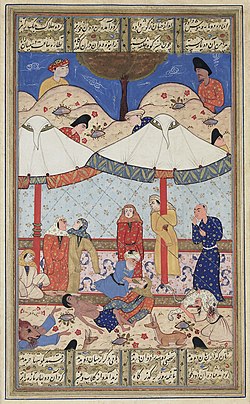
Layla and Majnun Ki Mazar Layla and Majnun
, also known as The Madman and Layla - in Arabic مجنون و ليلى (Majnun and Layla) or قيس وليلى (Qays and Layla), in Persian: لیلی و مجنون (Leyli and Madjnun), (Leyli və Məcnun) in Azeri - is a classical Arabic story of star-crossed lovers. It is based on the real story of a young man called Qays ibn al-Mulawwah (Arabic: قيس بن الملوح) from the northernArabian Peninsula. In one version, he spent his youth together with Layla, tending their flocks. In the other version, upon seeing Layla he fell passionately in love with her. In both versions, however, he went mad when her father prevented him from marrying her; for that reason he came to be called Majnun Layla, which means "Layla's Lunatic."
When Qays heard of her marriage, he fled the tribe camp and began wandering the surrounding desert. His family eventually gave up on his return and left food for him in the wilderness. He could sometimes be seen reciting poetry to himself or writing in the sand with a stick.[edit]StoryQays ibn al-Mulawwah ibn Muzahim, was a Bedouin poet. He fell in love with Layla bint Mahdi ibn Sa’d from the same tribe, better known as Layla Al-Aamiriya. He soon began creatingpoems about his love for her, mentioning her name often. When he asked for her hand in marriage her father refused as this would mean a scandal for Layla according to Arab traditions. Soon after, Layla married another man.
Layla moved to present-day Iraq with her husband, where she became ill and eventually died. Qays was later found dead in the wilderness in 688 A.D. near an unknown woman’s grave. He had carved three verses of poetry on a rock near the grave, which are the last three verses attributed to him.
Many other minor incidents happened between his madness and his death. Most of his recorded poetry was composed before hisdescent into madness.
Among the poems attributed to Qays ibn al-Mulawwah, regarding Layla:[1]
[edit]Variations
In India it is believed that Laila and Majnu found refuge in a village in Rajasthan before breathing their last. The 'graves' of Laila and Majnu are believed to be located in the Bijnore village near Anupgarh in the Sriganganagar district. According to rural legend there, Laila and Majnu were from Sindh and escaped to these parts and died there. Hundreds of newlyweds and lovers from India and Pakistan, despite there being no facilities for an overnight stay, attend the two day fair in June.
There is also a Laila-Majnu tomb in Al-Hofuf, Saudi Arabia.
Another variation on the tale tells of Laila and Majnu meeting in school. Majnu fell in love with Laila and was captivated by her. The school master would beat Majnu for paying attention to Laila instead of his school work. But some sort of magic happened. Majnu was beaten but Laila would bleed for his wounds. Word reached their households and their families feuded. Separated at childhood, Laila and Majnu met again in their youth. Laila's brother, Tabrez, would not let Laila shame the family name by marrying Majnu. Tabrez and Majnu quarreled; stricken with madness over Laila, Majnu murdered Tabrez. Word reached the village and Majnu was arrested. He was sentenced to be stoned to death by the villagers. Laila could not bear it and agreed to marry another man if Majnu would be kept safe from harm in exile. Laila got married but her heart longed for Majnu. Hearing this, Laila's husband rode with his men to the desert towards Majnu. He challenged Majnu to the death. It is said that the instant Laila's husband's sword pierced Majnu's heart, Laila collapsed in her home. Laila and Majnu were said to be buried next to each other as her husband and their fathers prayed to their afterlife. Myth has it, Laila and Majnu met again in heaven, where they loved forever.
History and influencePersianization of the story
From Arab and Habib folklore the story passed into Persian literature. Thestory of Lili o Majnoon was known in Persian at least from the time Rudaki who mentions the lovers.
Although the story was somewhat popular in Persian literature in the 12th century, it was the Persian masterpiece of Nezami Ganjavi that popularized it dramatically in Persian literature. Nezami collected both secular and mystical sources about Majnun and portrayed a vivid picture of the famous lovers . Subsequently, many other Persian poets imitated him and wrote their own versions of the romance . By collecting information from both secular and mystical sources about Majnun, Nizami portrayed such a vivid picture of this legendary lover that all subsequent poets were inspired by him, many of them imitated him and wrote their own versions of the romance[3]. Nezami uses various characteristics deriving from 'Udhrite love poetry and weaves them into his own Persian culture. He Persianises the poem by adding techniques borrowed from the Persian epic tradition, such as "the portrayal of characters, the relationship between characters, description of time and setting, etc.".
In his adaptation, the young lovers become acquainted at school and fell desperately in love. However, they could not see each other due to a family feud, and Layla's family arranged for her to marry another man [4]. It is a tragicstory of undying love much like the later Romeo and Juliet, which was itself said to have been inspired by a Latin version of Layla and Majnun to an extent.[5] However, Shakespearean scholars deny any such influence.[6] This type of love is known in Arabic culture as "Virgin Love" (Arabic: حب عذري), because the lovers never married or made love. Other famous Virgin Love stories are the stories of "Qays and Lubna", "Kuthair and Azza", "Marwa and Al Majnoun Al Faransi" and "Antara and Abla". The literary motif itself is common throughout the world, notably in the Muslim literature of South Asia, such as Urdu ghazals.
According to Dr. Rudolf Gelpke: Many later poets have imitated Nizami's work, even if they could not equal and certainly not surpass it; Persians, Turks, Indians, to name only the most important ones. The Persian scholar Hekmat has listed not less than forty Persians and thirteen Turkish versions of Layli and Majnun.[7]. According to Vahid Dastgerdi, If one would search all existing libraries, one would probably find more than 1000 versions of Layli and Majnun.
[edit]Azeri adapation
The Azerbaijani language adaptation of the story, Dâstân-ı Leylî vü Mecnûn (داستان ليلى و مجنون; "The Epic of Layla and Majnun") was written in the 16th century by Fuzûlî. Fuzûlî's version was borrowed by the renowned Azerbaijani composer Uzeyir Hajibeyov, who used the material to create what became the Middle East's first opera. It premiered in Baku on January 25, 1908. The story had previously been brought to the stage in the late 19th century, when Ahmed Shawqi wrote a poetic play about the tragedy, now considered one of the best in modern Arab poetry. Qays's lines from the play are sometimes confused with his actual poems.
[edit]Other Influences
The enduring popularity of the legend has influenced Middle Eastern literature, especially Sufi writers, in whose literature the name Layla refers to their concept of the Beloved. The original story is featured inBahá'u'lláh's mystical writings, the Seven Valleys. Etymologically, Layla is related to the Hebrew and Arabicwords for "night," and is thought to mean "one who works by night." This is an apparent allusion to the fact that the romance of the star-crossed lovers was hidden and kept secret. In the Persian and Arabic languages, the word Majnun means "crazy." In addition to this creative use of language, the tale has also made at least one linguistic contribution, inspiring a Turkish colloquialism: to "feel like Layla" is to feel completely dazed, as might be expected of a person who is literally madly in love.
This epic poem was translated into English by Isaac D'Israeli in the early 1800s allowing a wider audience to appreciate it.
Layla has also been mentioned in many works by the notorious Aleister Crowley in many of his religious texts, perhaps most notably, in The Book of Lies.
[edit]Popular culture
Recent News
Published in "Punjab Kesari"
News from Print Media
1) Rajasthan Patrika - Sri Ganganagar News
2) Danik Bhaskar - Sri Ganganagar News 3) Punjab Kesari - Sri Ganganagar Local E Paper Useful Links
1) Rajasthan State Ganganagar Sugar Mill Ltd
2) Royal Heritage Liqueur from Sri Ganganagar 3) Dav School Sri Ganganagar 4) Nosegay Public School Sri Ganganagar 5) Online Bus Tickets India News
Forecast Satellite Photos
  Stock market
Congrats now u can explore this site on www.myganganagar.com
Note - this service wtill be activated with in 24 hours...............
Sri Ganganagar
Sign In or Register to add photos
A beautiful place sriganganagar's pics are here.....you also can upload it in this website.....
|